
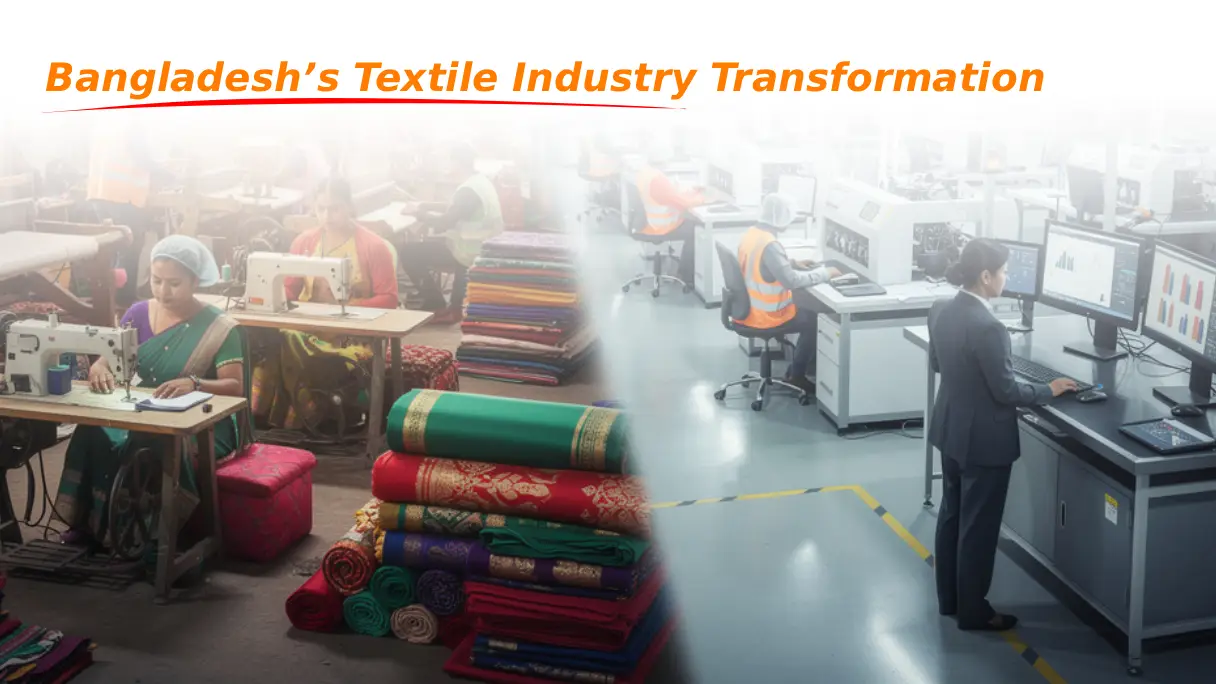
Bangladesh’s Textile Industry Transformation
Bangladesh's textile and apparel industry has evolved from a small manufacturing sector into one of the world's most important apparel sourcing destinations. Today, the industry plays a vital role in the country's economy, generating export earnings, creating millions of jobs, and strengthening Bangladesh's position in global trade.
This transformation did not happen overnight. It was driven by strategic investments, policy support, entrepreneurial leadership, and continuous development across the textile value chain.
The Early Challenges
Before the rapid expansion of the textile sector, Bangladesh's garment industry largely operated under a Cut-Make-Trim (CMT) model. Most factories depended heavily on imported yarn, fabrics, and accessories, resulting in longer lead times and higher production costs. Domestic textile manufacturing capabilities, particularly in woven fabrics, were limited, and many mills operated with outdated machinery and technology.
At the same time, the industry faced shortages of skilled textile engineers, technicians, and modern production facilities. These limitations restricted productivity and reduced the sector's ability to compete with more advanced manufacturing nations.
Developing Strong Backward Linkages
One of the most important milestones in Bangladesh's industrial journey was the development of backward linkage industries. Significant investments were made in spinning, knitting, dyeing, finishing, and fabric production facilities.
As local yarn and fabric production increased, manufacturers became less dependent on imports. This allowed factories to reduce lead times, improve supply chain efficiency, and respond more quickly to buyer demands. The knitwear sector, in particular, achieved remarkable growth through increased use of locally produced yarn and fabrics.
The expansion of dyeing, printing, and finishing operations further strengthened the industry's competitiveness in global markets.
Preparing for a New Global Trade Environment
A major turning point came as the global apparel industry prepared for the end of the Multi Fibre Arrangement (MFA) quota system in 2005. Many analysts predicted significant challenges for developing apparel-producing countries.
In response, Bangladeshi manufacturers invested in productivity improvements, efficiency enhancement, and supply chain development. These preparations helped the industry remain competitive even after quota restrictions were removed, allowing exports to continue growing in subsequent years.
Expanding Export Opportunities
Bangladesh also benefited from preferential market access in several major economies. Duty-free access to the European Union under the Everything But Arms (EBA) initiative, along with favorable trade arrangements in markets such as Canada, Australia, and Norway, helped accelerate export growth.
These opportunities enabled Bangladeshi manufacturers to strengthen relationships with international brands and expand their presence in global apparel supply chains.
Employment and Social Impact
The textile and apparel sector has become one of the largest employment generators in Bangladesh. Millions of people have found jobs within factories and related industries, with women making up a significant portion of the workforce.
This growth has contributed to rural economic development, increased household incomes, and greater participation of women in the formal economy. The industry's social impact extends far beyond manufacturing, influencing education, healthcare access, and community development across the country.
Policy Support and Industry Development
Government initiatives and industry associations have played a key role in supporting the sector's growth. Export promotion activities, bonded warehouse facilities, financial incentives, and stronger connections with international buyers helped create a favorable environment for investment and expansion.
These measures encouraged entrepreneurs to establish new factories and modernize existing operations, contributing to sustained industry growth.
Building Human Capital
As the industry expanded, the need for skilled professionals became increasingly important. Educational institutions specializing in textile engineering and apparel technology began producing graduates equipped with modern industry knowledge.
Organizations such as Bangladesh University of Textiles (BUTEX) and other academic institutions contributed to the development of a skilled workforce capable of supporting increasingly sophisticated manufacturing operations.
The Shift Toward Value Addition and Innovation
Today, Bangladesh's textile and apparel industry is moving beyond basic garment manufacturing. Industry leaders are increasingly focusing on value-added products, advanced textiles, functional apparel, and innovation-driven manufacturing.
Investment in automation, digital technologies, sustainable production methods, and product diversification is helping manufacturers improve profitability and remain competitive in a rapidly changing global market. Industry experts believe future growth will depend on innovation, technical expertise, and the ability to produce higher-value textile products.
Looking Ahead
Bangladesh's textile and apparel industry has come a long way from its early days of import dependence and limited production capabilities. Through investment, entrepreneurship, policy support, and workforce development, the sector has transformed into a cornerstone of the national economy.
As global demand evolves, the industry's future will be shaped by sustainability, technology adoption, innovation, and stronger integration across the textile value chain. By continuing to invest in these areas, Bangladesh is well positioned to maintain its status as one of the world's leading textile and apparel manufacturing hubs.